


The Kingdom of Saudi Arabia is the world’s largest oil exporter. Major seaports in the country are capable of carrying out their responsibilities like imports, exports, cargo handling, and storage facilities.
If you’re planning to ship from China to Saudi Arabia or export to other destinations from KSA, you will find the most convenient port today. This article has listed 14 largest ports in Saudi Arabia.
1. Jeddah Islamic Port

Jeddah Islamic Port is located in the second-largest city of Saudi Arabia, Jeddah. This city is next to the Red Sea. It is the busiest seaport that handles all types of cargo goods. So, the Jeddah seaport is considered an international maritime trade hub. The main purpose of this trade hub is to supply goods to Mecca and Medina.
The port was founded during the regime of Caliph Uthman Bin Affan in 645 AD. 65% of Saudi Arabia’s trade occurs through this port. Why? Because the annual handling capacity of this port is approximately 130 million tons. This seaport also has a load capacity of 7.5 million containers every year.
The Port Authority of Jeddah manages this port which covers an area of about 1,250 hectares (12.5 km2). The seaport comprises 3 main terminals which consist of different sub-terminals for passengers, bulk cargo, general goods, petroleum, and containers. Additionally, the port has a dedicated terminal for livestock, handling a trade of 7 million animals annually.
The Jeddah Islamic Port contains 62 berths that are 12.5 km long with a draft of 18 meters. These berths have a significant handling capacity of around 14,000 standard containers. Each year the seaport is visited by 5,000 ships that contain both the cargo and the passengers.
The port is equipped with 1,750 modern logistics equipment.
Storage Space
Jeddah Port has a storage area of 3.9 km2 that consists of both open ( 3.5 km2) and covered space (0.4 km2). The covered area contains portable umbrellas and 59 warehouses. Fueling depots are also available there.
Terminals Specialized For Containers
There are 3 terminals specialized only for containerized cargo. These are:
- North Container Terminal has an area of 1.07 square kilometers. It specializes in handling reefer containers, which carry temperature-sensitive goods. The terminal features 7 berths that can accommodate the largest container vessels.
- Southern Container Terminal spans around 0.62 square kilometers. 6 docking sites are there with a draft of 16 meters.
- Red Sea Gateway Terminal covers 0.5 square kilometers. The deepwater shipping lane here has a width of 300 meters. There are 4 anchoring berths for modern vessels. The terminal also contains 2 buildings, 1 feeder quay, and 1 warehouse.
The north and southern terminals collectively handle 7.5 million Twenty-foot Equivalent Units per year.
2. King Abdul Aziz Port

King Abdul Aziz Port is the largest port in the Persian Gulf. This seaport spans around 19 km2 in Dammam City, therefore, also known as Dammam Port. The port is the primary export facility for the oil industry.
King Abdulaziz bin Abdulrahman Al Saud laid the foundation of this seaport. He signed an agreement with a famous oil & gas company, Saudi Aramco, for its development. It is the busiest and the 3rd major port of the MENA (Middle East and North Africa) zone.
The seaport is connected to the capital city, Riyadh, and other dry ports through the railway line.
Terminals
King Abdul Aziz Port contains 3 major terminals and other sub-terminals. The annual capacity of this seaport is 105 million metric tons.
The sub-terminals include 2 cement terminals (1 for black cement and 1 for white cement), 1 iron ore terminal, 1 cold chain terminal, 1-grain terminal (10 bulk storage tanks), and 2 oil & gas terminals.
The port has 2 container terminals. The first one is old, covering a 0.7 square kilometers area. It is handled by the International Port Services (IPS) company. 2 RORO and 6 container docking sites are present here.
The other container terminal was founded in 2012 and is connected to railway lines.
Berths
The port has 43 berths, each specialized for different functions.
| Berths | Purpose |
| 1, 2, 3 | Grain handling (mainly unloading) |
| 4 to 9 | General cargo handling and railway line is connected to these berths |
| 10 | Bagged fertilizers management |
| 11, 12, 13 | General cargo loading and unloading |
| 14 to 22 | Roll on and Roll off ramps (vehicle handling) |
| 23 to 26 | Container handling |
| 27, 28, 29 | Project cargo management and RORO ramps |
| 30 | Grain export handling |
| 31 to 34 | Specialized for Gray cement with general cargo |
| 35 | Provides a cold storage facility and RORO ramps |
| 36 | Explosives handling facility |
| 37, 38 | White cement, Gray cement, and Bulk ores (Iron Ore, Copper Ore, Coal, Cement, Gypsum, etc.) |
| 39 | Edible oils and clinker loading and unloading |
| 40 to 43 | General cargo, automobiles, |
The seaport has a 215 meters long vessel maintenance facility, an employee’s residential facility, and a supermarket. It also has a mosque and a port tower of 310-foot height.
3. King Fahad Industrial Port, Yanbu

King Fahad Industrial Port is located in Yanbu city of Al-Madina province. It is strategically positioned on the western side of Saudi Arabia along the Red Sea coast.
Want to export crude oil and petrochemical products? If so, then this port is specially built for you if you are in its proximity. For imports, industrial machinery is the main cargo.
It is a 15 km long industrial port that covers an area of 6.8 km2. There are 4 warehouses, each of 9,000 m2 area, and separate storage space of 275,000 m2 for containers only. The open cargo yard spans around 10,000 square meters for storing general cargo. The fleet includes 15 tugboats as well as 18 service boats.
The King Fahad Industrial Port is equipped with 10 next-generation terminals with 34 berths. These terminals and berths can handle cargo of 210 million metric tons annually. The ships of 500,000 tonnes visited the port and anchored there.
The following are the main terminals of the port:
- The Crude Oil Terminal includes 5 berths. These berths can take in ships with a load capacity of 500,000 DWT.
- Natural Gas Terminal has 3 berths with a draft of 18.3 meters that deals with propane, naphtha, etc.
- The Petrochemical Terminal contains 7 docks that can anchor ships of 40,000 DWT. This terminal is used for the export of glycol and propylene.
- The Bulk Terminal comprises 2 quays with an area of 500 meters and a depth of 16 meters. It deals with sulfur transportation and receives vessels of 60,000 DWT.
- The Petroleum Derivatives Export Terminal has 5 berths with a capacity of 150,000 DWT for tankers. These are specifically oil tankers that deal with petroleum-based products like diesel oil and benzene.
4. King Fahad Industrial Port, Jubail

It lies in Jubail City which is situated in the eastern province of the country. The seaport mainly handles the trade from the Middle East region of the world. King Fahad Industrial Port in Jubail was established in 1982 by the late King Fahad Bin Abdulaziz.
The infrastructure is designed on the basis of handling raw materials imported from local and international markets. The Jubail industrial city is known for its largest petrochemical complexes. These complexes handle the export of petrochemical products. Fertilizer and sulfur export is also done through this port.
The port spans an area of 680 hectares with a cargo capacity of 70 million metric tons. The following are the 5 terminals of this seaport:
- General Cargo Terminal
- Marine Equipment
- Bulk Cargo Terminal
- Petrochemical & Petroleum Products Terminal
- Open Sea Tanker Terminal
The King Fahad Jubail seaport was modernized and extended to minimize the traffic. Therefore, it consists of 34 berths each for different types of vessels and cargo.
Among these, 5 are liquid bulk berths, 1 LPG berth, 2 open berths, 2 RORO berths, 7 Dry Bulk berths, 1 refined product berth, 5 berths for accepting low draft vessels, and 3 berths with deep water clearance for high draft vessels.
5. Jubail Commercial Port

King Khalid Ib Abdulaziz Al Saud laid the foundation of this port for the purpose of commercial trade. He initiated the construction of this port in 1976 which was finished by 1979. It is located in the central region of industrial facilities of Jubail City. This marine port is next to the Arabian Gulf and is positioned on the country’s central coast.
The seaport is located 80 kilometers from the Dammam port. It is connected to the capital city Riyadh. The port location plays a vital role in making it one of the largest ports in the country. The main reasons are the ease of access to the customers and lower freight rates.
It spans around 4,400 hectares with 16 berths of 36 million tonnage capacity and a draft of 14 meters. There are warehouses and open storage space for accommodating general and bulk cargo. The port was once a popular fishing spot for the city’s fishermen.
Now, Jubail Commercial Port is modernized and has different types of boats for cargo shipments. These include mooring boats, tugboats, and pilot boats. Moreover, the port is also equipped with 6 modern quay cranes for handling bulk cargo.
This seaport is mainly divided into 3 terminals. These terminals commonly deal with containers, bulk cargo, industrial goods, and general cargo. They consist of a general cargo terminal which contains 8 berths, a container, and a bulk terminal, each comprising 4 berths.
6. Yanbu Commercial Port

Yanbu Commercial Port lies near the west coast of the Red Sea. This seaport is connected to King Fahd Industrial Port and Duba Port. It is the oldest port in Saudi Arabia established in 1965 during the rule of King Faisal. Medina and Qassim are the main serving sites for this port.
Yanbu Port is the main entrance and exit point for passengers to the holy city of Medina for pilgrimage purposes. It serves as the complimentary port of the King Fahad Industrial Port. The port is equipped with modern facilities for handling general and bulk grain cargo. Its main terminals are:
- Passenger terminal (accommodate 1,500 passengers at a time)
- Grain terminal (containing 2 bulk storage silos with a storage capacity of 40,000 metric tons)
- General cargo terminal
The port contains 12 berths with an annual handling capacity of 15 million metric tons.
7. Jizan Port

Jizan port lies on the southwestern side of the country in Jizan city, next to the Red Sea coast. Jizan city lies in the Jizan province, the second smallest province in Saudi Arabia. The port is also known as Jazan, Gizan, or Gazan Port. It was established in 1976 by King Abdulaziz Al Saud.
The Jazan port is connected with Europe, East Africa, and the Middle East for trade reasons. The port’s primary purpose is the import of livestock from Africa. The international trade of barley, cement clinker, and general cargo is also done through this port.
This port also receives passengers through its dedicated passenger terminal.
It is a mid-sized port equipped with modern facilities that cover 500 hectares of land. There are 16 warehouses, refueling stations, residential buildings, a control tower, 2 desalting facilities, and one power station. The loading capacity of this port is 5 million tons.
The Jizan port contains 12 berths with 3 entry channels. These berths also include some SPM (Single Point Mooring) berths. In addition, there is also one oil terminal.
8. Port of Ras al Mishab

Ras al Mishab port lies on the northeastern coastline of Saudi Arabia. Dry bulk cargo, containerized, and break bulk shipments are mainly handled by this port. This seaport essentially serves facilities for the Al Batin military city. This city is 500 kilometers away from the port by road.
There are no medical facilities and no terminals here. The storage area is open and equipped with modern mobile cranes for handling goods.
Facts
- The port has a 12.2-meter-long water channel for vessel entrance.
- It has a docking area that spans around 11 meters.
- The anchorage space is approximately 9.1 meters.
- The seaport can accommodate vessels of 500 feet in length.
- The ship’s loading capacity is 2,500 DWT.
9. Port of Ras Tanura
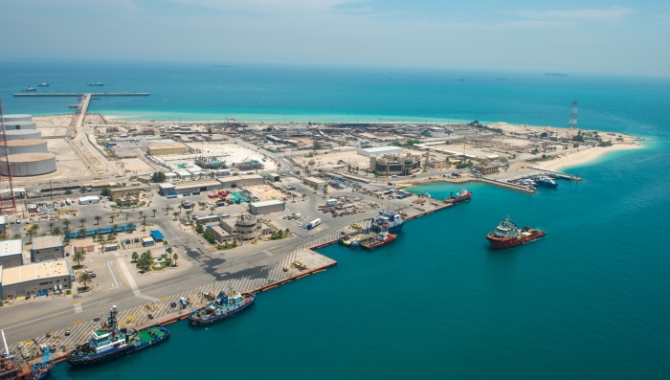
Ras Tanura Port lies on the northeastern coast, close to Dammam city. The port mainly serves as an oil port, handling 90 percent of Saudi Arabia’s crude oil exports. In addition, other refined products are also transported through here.
The port has 2 main berths on the Arabian Gulf and four artificial islands (8 berths). It comprises an oil refinery with a 500,000 barrels refining capacity in 24 hours. There is an oil storage facility that can accommodate 33 million barrels of oil at once.
The port exports approximately 6.5 million barrels (7%of international oil needs) of oil each day.
This region of Saudi Arabia also has its own airport and highway infrastructure. The modern highway facilitates export and import movements in the area. Even if it is not a big port, it is prepared to manage mid-size cargo. This seaport also serves different types of military practices.
Piers
There are 2 piers on this port:
- North Pier is 670 meters long and 33 meters wide. It is equipped with 6 berths with a depth of 15.2 meters approximately.
- Southern Pier contains 4 berths that receive a load of 30,000 tons. The pier has a length of 366 meters, a width of 32 meters, and a depth of 10.06 meters.
10. Port of Duba

Duba Port is situated on the north side of the Red Sea Coast, in the north-northwest of Jeddah (780 kilometers). This port is also northwest of Yanbu (480 kilometers) and is nearest to the Suez Canal. Now the port name has changed to Port of NEOM which means “New Future”.
Duba Port is the nearest seaport to Mediterranean countries. Therefore it serves Egypt, Turkey, Cyprus, France, and Greece in terms of trade and passenger transport. General cargo, dry bulk, breakbulk cargo, project cargo, and Ro-Ro vessels are cargo types transported through this port.
The port spans over 1,200,000 hectares with 3 main terminals. The port area has a handling capacity of 15,000,000 metric tons annually. It contains 1,350 meters long and 15 meters deep 8 berths with a 12,000 m2 area dedicated for cargo storage.
The port contains a control tower to monitor the movement of vessels.
Major Imports
Its major imports are:
- Building materials
- Industrial equipments
- Vehicles
- Foodstuffs
11. Port of Rabigh

Rabigh Port is located on the eastern side of the Red Sea coast in the north of Jeddah. Its other name is “Sherm Rabegh” and is secured by the natural reef barrier. The deep-water port of Rabigh mainly handles general cargo, liquid bulk cargo, and dry bulk goods.
Rabigh Refining & Petrochemical Company handles all the port activities. These include managing 300 vessels yearly and transporting 14 million tons of sulfur. The port can accommodate ships of 350 meters LOA with an alongside depth of 23.5 meters.
Rabigh Port contains 5 berths where export of petroleum (10 million tons) and import of crude oil (10 million tons) occurs annually. It does not have a terminal.
12. Port of Ras al Khafji

Ras Al Khafji Port lies in the partitioned zone of Saudi Arabia and Kuwait. It is 15 kilometers away on the northeastern coast of Saudi Arabia. The port mainly handles the transport of fuel oil, naphtha, crude oil, and general cargo. 60 vessels are received through this port annually.
The port contains 4 tanker loading berths and an oil terminal of 21.3 meters depth. The depth of the anchorage area of this port is 20.1m. Vessels of 300,000 DWT can be handled through this port. The cargo pier depth of this port is 12.2 meters.
13. King Abdullah Port

King Abdullah Port lies in King Abdullah Economic City (KAEC). It is situated 90 kilometers away in the north of Jeddah. Yanbu, Rabigh, and Industrial Valley are connected to it through highways. The port mainly serves regions of East Africa, the Middle East, and the North.
Crown Prince Mohammed bin Salman inaugurated this commercial port in 2019. It is the first privately owned port managed by the Ports Development Company (PDC). In 2021, the port was enlisted in the world’s best 20 container ports.
The port has a total area of 17.4 km2 with a handling capacity of 25 million TEU containers, 10 million tonnes dry bulk, 15 million tonnes agri bulk, 5 million tonnes general cargo, and 15 million CEUs RO/RO cargo.
King Abdullah Port mostly handles the import and export of food products, building materials, and pharmaceutical items. 13% of the international trade occurs through this port.
14. Ras Al Khair Port

Ras Al Khair Port is located on the eastern coast of the Eastern Province. It is 37 miles north of Jubail. The port has a direct connection to mines through the railway lines which facilitates the export of raw materials. Aluminum goods and ammonium phosphate are the major exports of this port.
Ras Al Khair Port covers an area of 23 km2, accommodating 14 berths and 1 terminal with 2 terminal operators. The port’s annual capacity for handling cargo is 35 million tons.
Final Thoughts
So, all of the above mentioned 14 KSA seaports are important to help you in all your import and export needs. At BanSar, we will help you in all your shipping needs from China to any global destination. For all your customs clearance, and freight forwarding, contact us now.

