


People often wonder if a reefer or a dry van is the right choice. This article will compare them and help you choose the right truck for you. Read on to make an informed decision.
Definition of a Dry Van

A dry van is an enclosed trailer people commonly use for transporting cargo that doesn’t need temperature control. You can usually carry loads weighing 42,000 to 45,000 pounds in these trucks. The manufacturing, logistics industries, and retail industries typically use Dry vans. Clothes, furniture, appliances, non-perishable food items, electronics, and other palletized goods are normally transported using these trailers.
Dry vans are usually built with thin and lightweight walls. This is done to maximize cargo space. These carriers are typically 48 to 53 feet long, 8 feet wide, and about 8 and a half feet in height. You do not need specialized service for temperature control to keep these trailers in good shape.
Definition of a Reefer Truck

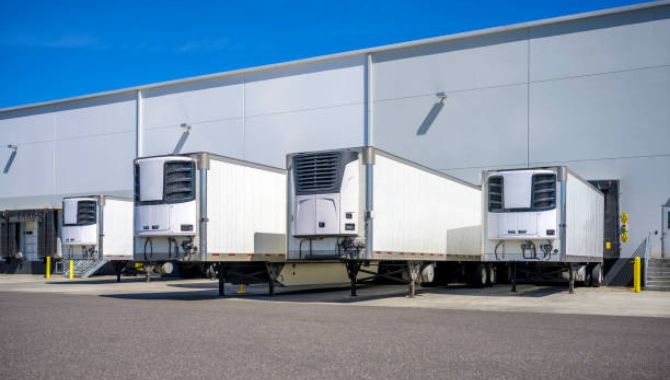
Transporters use Reefer Trailers to haul temperature-sensitive goods. You can carry a lower weight in these compared to a dry van. That’s because of the added weight of the insulation and refrigeration equipment. You can use Reefers in the food industry, pharmaceuticals, floriculture, and any sector requiring climate-controlled transport.
These trucks are usually the same size as dry vans but the interior spaces are smaller. That’s because the climate-control equipment on the walls, floor, and roof take up some space. You can maintain temperatures between -22°F to 95°F in a reefer depending on what cargo you’re hauling. The use and maintenance can be costly because you need to make sure that the refrigeration unit functions properly.
Dry Van vs Reefer Truck: Key Differences to Consider

Before choosing the trailer that suits your needs, you should know the key differences between the two. Below you’ll find all the differences nicely categorized for your convenience.
Typical Usage, Flexibility, and Temperature Control
You’ve already learned that reefers haul temperature sensitive goods and dry vans don’t. But did you know that you can haul dry, climate-neutral goods in reefers? Hauling these goods would be less efficient because of the reefer’s smaller space but you’ve got the choice. This makes reefers more versatile than dry vans.
Dry vans don’t have thick walls like reefers. That’s because there’s no insulation or refrigeration equipment. That gives you more space to haul more dry goods. It lets you haul more weight, too. You can control temperature in a reefer to keep your goods in perfect shape. That is something you can’t do with dry vans. Some reefers even have separate partitions for different temperatures.
You can use reefers to haul Perishable foods, pharmaceuticals, chemicals, flowers, electronics, and artwork. In a dry van you can carry boxed and palletized freight like furniture, electronics, clothing, auto parts.
Structural Design and Capacity
You can find different variations of dry vans. Some are as small as 24 feet in length. But if you’re using it commercially, 48 to 53 feet variations are the best. Reefer trucks don’t have that many variations. You’ll basically find the 48 to 53 feet ones. Dry vans will give you the maximum space and reefers will give you maximum protection.
You can carry up to 45,000 pounds in a large dry van. But in a same sized reefer, you can’t carry as much. That’s because the insulation and refrigeration equipment weigh around 1000 pounds. So, because of the smaller space and added weight, you’ll only be able to carry about 42,500 pounds.
Costs and Maintenance
Dry vans will cost you less because you don’t need extra fuel to run any refrigeration unit. You’ll need that for Reefers and the equipment will also cost you. You’ll also need to pay more in transportation costs if you use a reefer. On average, the rates are around $0.50 per mile higher compared to dry vans.
You’ll also need specialized care for reefers, at least once a year. You need to make sure that the insulation and refrigeration unit is running perfectly. You don’t need to do that for dry vans. You’ll also need to pay more for reefers if you want to buy a truck and not rent it.
Pros & Cons of a Dry Van

Now that you know the differences, let’s take a look at the pros and cons of a dry van.
Pros
- You can transport goods that don’t require temperature control.
- Dry vans ensure the safe transport of goods by protecting them from weather conditions and theft.
- You’ll have lower operating and maintenance costs. So it’s a cost-effective option.
- The loading and unloading process is simple, so you’ll save time and labor costs.
- You’ll have more interior cargo space for larger shipments.
- Dry vans are widely available and it is quite easy to find one when you need it.
Cons
- You do not have temperature control and can’t haul perishable goods.
- They can be vulnerable to extreme weather conditions like heat waves, cold waves, and heavy precipitation. These external factors might affect the cargo.
- There are no partitions or specialized compartments. This shortage can bring challenges for the commodities that require separation.
- As there are no built-in features to keep goods in place, you’ll need to properly secure the cargo.
Pros & Cons of a Reefer Truck

Just like dry vans, reefer trucks also have their own advantages and lackings.
| Pros | Cons |
| You can transport temperature-sensitive goods | Lower interior cargo space because of the insulation and refrigeration unit |
| You can maintain a wide range of temperatures (from -22°F to 95°F) | It’ll cost you more to purchase or rent compared to dry vans |
| You can use reefer trucks to haul both refrigerated and dry goods | You’ll need specialized maintenance service for the refrigeration unit |
| Cargo is from external temperature fluctuations and kept in their optimal condition | The refrigeration unit needs fuel. This adds to your costs |
| Some models have partitioned compartments for different temperature zones within the same truck | |
| Perfect for transporting perishable goods like food, pharmaceuticals, and flowers |
Dry Van vs Reefer: Choosing the Best Option

Both trailers have their own advantages and disadvantages. If you want to know which one is better, there’s no definite answer. It all depends on how you want to use the trailer.
Dry vans are the right choice if your freight transports non-perishable goods. It can be an economic solution for bulk transport of temperature-neutral goods. It is also suitable for a wide variety of products. You can transport more goods with a lower cost.
Reefer trailers, on the other hand, can be the right choice if you haul frozen goods. These should also be used to haul other perishable goods needing climate control. The silver lining is that these sensitive goods are always in demand. A study says that the demand for reefers is supposed to grow by 4% between 2023 and 2028. However, there’s also a high risk of damage and added costs if the refrigeration unit malfunctions.
Conclusion
Choosing between a dry van and a reefer truck basically depends on your specific needs. We have discussed everything necessary to make a decision between the two. Choose the one that best suits your needs and get down to business.
FAQ
Is It Possible to Make a Reefer Serve as a Dry Van?
Yes, you can definitely repurpose a reefer trailer to use it like a dry van. Just turn off the refrigeration unit and you’re good to go.
Can I Carry Both Dry and Frozen Goods in a Reefer?
The insulation in a reefer can protect sensitive cargo from extreme or external temperatures, even without active cooling. If you need to carry both types of goods, reefers can provide you with a versatile solution.
Does a Reefer Use Fuel if Insulation Is Turned Off?
Yes, the insulation unit might exhaust fuel even if it’s turned off. So, it’s not the best choice for you to haul dry goods in reefers regularly.

